THE BACKLOT
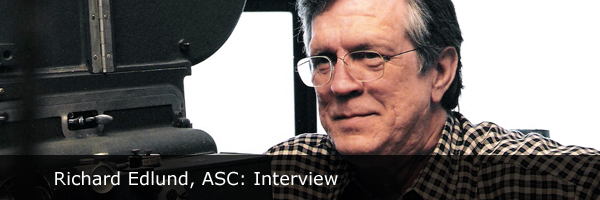
By William Kallay
For somebody who has supervised some of the most
memorable visual effects in film history, Richard Edlund is a pretty
down to earth guy. By talking to him, you’d never expect that this North
Dakota native not only works on his car, but has also won four Academy
Awards for his work on the original "Star Wars" trilogy and "Raiders Of
The Lost Ark." Edlund is not egotistical, where he could be. After all,
he’s worked with some of the biggest creative talents in the history of
Hollywood moviemaking. Who? George Lucas. Steven Spielberg. Ivan
Reitman. The list of people is as infinite as Edlund’s considerable
accomplishments. From visual effects at Industrial Light & Magic (ILM),
to running his own company, BOSS Film Studios, he’s certainly got a
well-rounded resume, to say the least.
Edlund is not only known for his visual effects excellence, but is also
known for building state-of-the-art equipment for the big screen.
Through BOSS, he developed the ZAP, a super printer for compositing
visual effects shots in the 65mm format. And a number of films with his
imprint utilized 65mm for shooting footage. During the heyday of
photochemical visual effects, most work was performed in the VistaVision
or 65mm formats. The larger negative area of VistaVision (8-perf 35mm)
and 65mm allowed for clearer duplication through the act of compositing.
But with the evolution of computer generated imagery (CGI), large format
film has been used less. However, some films still utilize the bigger
frame. Thankfully, old habits "Die Hard."
Working as hard as ever, Edlund was gracious enough to take time to
visit with From Script To DVD at his Santa Monica, California office in
February, 2002. Edlund spoke about his work in visual effects, his days
at ILM, running BOSS Film Studios, and his work in 65mm.
Famous Shots
William Kallay, From Script To DVD: Can you tell our
readers how they can find some of your signature shots in various films?
Richard Edlund: Well, the opening of the Ark in
"Raiders Of The Lost Ark" [1981], of course. I was in charge of doing
that whole “Wrath of God” sequence at the end with Joe Johnston. The
opening shot in "Star Wars" [1977], that’s a significant one. Let’s see,
going back…the Marshmallow Man walking down Broadway ["Ghostbusters,"
1984]. Blowing up the Fox Tower in "Die Hard" [1988]. Let’s see, a
couple really good ones. Making four Michael Keaton’s in "Multiplicity"
[1996]. That was a damn near perfect project.
FSTDVD: One of my favorite effects in "Raiders" occurs
during the “Wrath of God” sequence. How did you come up with the “Nazi”
lens flare effect?
Edlund: I’m sure Steven [Spielberg] was looking for a
signature effect, something that had not been seen before. We were
portraying the “Wrath of God” where He shoots this lightning through all
these actors playing Nazis. When I was preparing to go over to London
for the movie, after we had storyboarded the sequences, I had these
harnesses made up which had asbestos pads in the back, and then they
fitted over the shoulder like a sandwich board. And in the front, there
were these little Halogen spotlights. And in the back was an FF33
flashbulb. These were flashbulbs that were built for high speed cameras,
like the Fastax camera in the ’50s. The flashbulbs lasted about
two-and-half seconds. They looked like a 150-watt lightbulb with a
magnesium foil inside of them. So we put those in back of the shirts of
all the Nazis. Each Nazi had this rig on, and then they had a wire going
down their pant leg to supply power to the lightbulb. They also had a
flashbulb hanging in their back. Then we scored their shirts, so that
the light would come through when the flashbulb went off. Each actor had
a little plunger in their hand, because I didn’t want all of the flashes
to happen simultaneously. We gave them slight counts, so that they would
go off sporadically, but all within a few seconds of each other.
FSTDVD: Everybody on the set must have needed
sunglasses.
Edlund: These flashbulbs were like the sun. I mean,
they’re incredibly bright! But that would give us a nice point source
for a flare that I wanted to get. I had done a lot of animated graphics
in the early ’70s with Bob Abel, so I’d experimented with lots of ways
of creating lens flares and modifying animated artwork. I came up with a
machine that had a mandrel. On the end of the mandrel was this little
wheel. It was about 1/4 of an inch in diameter that would rotate at a
high speed. By going back and forth on a path on a piece of glass, it
would polish a little groove into the glass. So I created a filter that
had a number of these grooves in a fan shape. When it was put on the
camera, it gave me a flare that had an arc. So there was this arced
flare that resulted from this filters, which I’ve only used for
"Raiders." I still have it, of course—the “Wrath of God” filter. So all
of sudden when you saw the “Wrath of God” begin, we animated those
shafts of lightning through the Nazis. I think it was John Van Vliet who
may have animated that. Because this was at the end of the movie, and
Steven is one hell of an act to follow, the climax had to be climatic.
It was a hell of a lot of fun to do that sequence. I’m still very proud
of it.
FSTDVD: You should be. It’s an incredible effect and an
incredible film.
Edlund: Dougie Slocombe was the cameraman on that. He’s
just a great guy. Poor guy now, he’s practically blind. He’s had retinal
problems. I know right after "Raiders," he had a detached retina, and I
was worried about it then. That was twenty years ago. He’s in his
eighties now, and he just received the ASC Lifetime Achievement Award
this year.
FSTDVD: "Raiders" was an excellent production from
script to the final cut. By looking at the final picture, one would
think that it cost an outrageous amount of money at the time.
Edlund: The interesting thing about that movie was that
it was that George [Lucas]'s attitude was this is a “B” movie, and he
didn’t want to be spending a lot of time like doing ten takes on a
scene. In other words, he’s shooting three takes, not ten. And if you
don’t finish the pages you have for the day, you tear them out and make
it work somehow. That’s the way they made movies in the ’30s and ’40s.
They were cranking them out. This irked Steven to have this kind of
pressure on him. I think it added to the verve of the movie, and it has
kind of this rambunctious kind of attitude -- the whole movie does. I
think part of it was because of that production pressure.
FSTDVD: And it has held up so well over the years, too.
Edlund: Definitely the best of the "Indiana Jones"
movies.
Beginning With A Thing
FSTDVD: How did you become involved with visual
effects?
Edlund: I got interested in movies when I was living in
Japan. And before that, in high school, I was the photo editor of the
yearbook. I also shot still sports pictures for the L.A. Examiner on
weekends. I was a real accomplished photographer. I had a high school
photographic teacher that was kind of a nerd, but he was really great!
He taught photography and physics. We had to mix developer and he
explained the functions of the different elements of the developer and
optics. I really had a great background in photography in that one
class. Plus I had a darkroom in my garage, always. I always loved
photography, because it’s an art that’s reachable through gadgets and
technology. I’m kind of a gearhead on one-hand, but I love composition,
images and photographic problems—the art of photography problem. Visual
effects is probably the most complicated and difficult area of
photography. That’s what drew me to it, I think. When I got out of the
Navy, I went to USC School of Cinema at night, and I was working during
the day. But after awhile, I thought, you know what, I’m just going to
get a job in the movies. So I started beating the doors and I got a job
with a guy named Joe Westheimer, who became a mentor to me. His company
did opticals, titles and inserts and special effects mostly for TV
shows, but we did some features, as well.
FSTDVD: Which television shows did you work on?
Edlund: I worked on "The Outer Limits" and the original
"Star Trek" -- those kind of shows. "Wild, Wild West" was a big contract
deal. We did inserts. They even used my hand in all the insert close-up
shots in "The Addams Family."
FSTDVD: You mean “Thing?”
[laughter]
Edlund: Thing. Because I happened to be there, right?
They’d set up these close-ups, Thing would have to light somebody’s
cigarette, or point to something or shift the car or something, you
know? So we’d set up these shots and use my hand.
FSTDVD: Did you make any of your own films during this
time?
Edlund: Yeah. In the late ’60s, I became a hippie and a
rock-and-roll photographer. I was a working hippie, so I did photo
sessions with rock-and-roll groups. I also did 16mm shorts, kind of
“pre-videos.” I’d film the Ventures out on the dry lakes, edit a
two-minute song that had about two hundred cuts in it.
FSTDVD: Didn’t you work on some commercials during the
1970s?
Edlund: I did. I met a guy named Bob Abel. He was doing
streak photography and animated graphics. I started shooting stuff for
him. We did a couple of commercials that were famous at the time.
FSTDVD: For instance?
Edlund: It was the 7-Up Bubbles commercial that had
these real fancy, pulsating, flashing graphics with star filters. Then
after about a year-and-half, I heard there was a movie called "Star
Wars" being set up. I talked to John Dykstra about it and agreed to come
on as a part of the core group that did "Star Wars."
FSTDVD: I’ve heard stories about the humble beginnings
of ILM.
Edlund: We started out with a big empty room with a
card table with a phone on it. We had to build the whole system up and
then shoot "Star Wars!"
Using VistaVision
FSTDVD: When you started with ILM, were you one of the
crew that actually went out and looked for the VistaVision cameras at
the time?
Edlund: Well, I discovered the VistaVision cameras when
I was at Abel’s. I was trying to get Bob Abel to buy that printer,
because everything we were shooting at Able’s was in the camera. It was
extremely complicated. We’d do shots and we’d get these standard
Edlund works on the AT-ATs in Empire
animation count sheets and tape them together. They would be about four
feet wide, five count sheets across. There’d only be like seventy-five
frames shot. So I’d shoot all day to get three seconds of film.
FSTDVD: When you got the VistaVision cameras for ILM,
was there a reason why you leaned towards those instead of 65mm cameras?
Edlund: There were a couple of reasons. "Star Wars" had
365 shots planned. I think it turned out to be more like 400 shots at
the end, or 420. I just looked at my storyboards the other day and there
were 428 storyboards.
FSTDVD: Wow.
Edlund: That was a hell of a lot of shots. VistaVision
was a really good format for that movie. Because the film goes through
the camera sideways, the camera can actually be smaller in profile. It
is actually more useful for model photography, because the models are
very close to the lens. In order to do that number of shots in the time
that we had, we decided to use really small models. The X-Wings were
only about 18 or 20 inches long. The Star Destroyer in the opening shot
was less than four feet long. So with 65mm, there’s more resolution and
more acuteness on the screen. You’d have to build bigger models, and
that just wouldn’t have worked. And besides, Doug Trumbull was snapping
up the 65mm equipment, because he was working on "Close Encounters"
across town while we were doing "Star Wars." The reason you go with a
large format in effects is because in the pre-digital days, you had to
dupe. So none of the shots that wound up in the movie were original
photography; they were all duplicates; they were all composites of
multiple elements put together on an optical printer. And if you didn’t
use a larger format to acquire your images, then the shots would look
“dupey.”
FSTDVD: Did you have any idea that there would be so
many advances within the film industry, just based on this film? For
instance: box office, sound technology, visual effects, and marketing,
to name a few.
Edlund: Well, it was a great historical point.
Ironically, the reason we were able to do "Star Wars" was because of
solid-state circuitry which had been invented for the space race. Space
Race technology made "Star Wars" possible.
Playing A Role
FSTDVD: What are some of your duties as a visual
effects supervisor?
Edlund: As a visual effects supervisor, it’s a complex
role. First of all, you have to figure out what it is that the director
wants to see. Then you have to figure out how to create a shot that will
give that effect to the audience. You also have to figure out how to do
it within a budget and within a time constraint. And then, you have to
deal with all the politics of budget and of interdisciplinary
communication. That is, talking to the costume designer and making sure
that someone isn’t wearing a pair of blue pants when we’re shooting a
blue screen. Or talking to the DP about how much depth-of-field you’re
going to need, or what light level he’s going to have to light for. You
have to keep track of a lot of things and make sure that all this stuff
is not gonna fight you when you start putting the shot together. It was
much more complicated and difficult in the photochemical era. It is so
easy to “pixel pound,” as we call it today. That is, going in and fixing
it in post-production, because you can do damn near anything nowadays.
It’s just a matter of time and money. That’s always been the case. But
then, also, you’re dealing with the temperament of the director. You’re
in charge of all these kind of things. Yet today, I lament that the
credit “visual effects supervisor” is not policed. In other words,
anybody can take that credit now, so the credit of visual effects
supervisor gets diluted.
BOSS Film Studios
FSTDVD: How did you get involved with running your own
company?
Edlund: When I finished "Return Of The Jedi" [1983],
ILM was not my cup of tea. I mean, it was just a different gestalt than
I was personally happy with. I wanted to give a shot to doing my own
thing. I made a deal with myself that I would finish the "Trilogy," then
I would leave ILM. When the "Trilogy" was finished, I was in complex
discussions with Ridley Scott on a movie called "Legend Of Darkness,"
which ultimately became "Legend" [1985].
The original idea on that was to shoot Darby O’Gill-style; using forced
perspective and cheating eye-lines, things like that, which is kind of
like a variation of what they did on "Lord Of The Rings" [2001] in order
to get the people to appear smaller. When I was finishing "Jedi," and
starting to pack up, I was talking to Ridley, but the project went south
for me because [producer] Arnon Milchan was worried about the budget for
"Blade Runner" [1982], which didn’t do well at the box office. It was
budgeted at about $20 million and went to $28 million or something like
that. He was worried that the same thing was going to happen on
"Legend." He said we’re not gonna do it Hollywood. We’re going to shoot
it in London and we’re gonna use little people. So that’s what they did.
They hired dwarves and midgets to do it and that picture went away.
During that time, I had accidentally herniated a disc while I was
working on my car. I had to go in the hospital to have an operation, and
the project had just fallen out with Ridley. I had already made a deal
with Trumbull to take over his facility, because he wanted to go off and
do something else, so I made a deal with him to take over that facility
based on doing the Scott project.
FSTDVD: You were caught in a tight spot.
Edlund: Yeah. When "Legend" went away, I was wondering,
“what the hell am I gonna do now?” I had all these great people lined up
and ready to go. And while I was in the hospital, I got a call from Ivan
Reitman to do "Ghostbusters." Then, the day after that, a call came from
Peter Hyams to do "2010" [1984]. So I put that deal together over the
phone, then I had to go down and negotiate it. And so as soon as I got
out of the hospital, I swung into action. We had the 65mm gear, but I
had to build optical printers and animation stands. My style of effects
was completely different from Doug’s, so I could only treat what was
there as sort of like a pile of parts. We had to reassemble them and
build things like optical printers with telecentric lenses. We built the
Super Printer for "Ghostbusters."
FSTDVD: That was the birth of BOSS Film Studios?
Edlund: Yeah. I ran BOSS for fifteen years and it was
quite a project. And it was a company I had to start. I’m not a
businessman. I have no formal business background. My background is all
photographic and art oriented. But when I left ILM, and in those days in
order to do what I wanted to do, I had to have all this fancy
photographic paraphernalia. I had no choice but to open up a company.
And so I did that, then I aquired and bootstrapped it basically. When
the digital thing started happening in the late-’80s/early-’90s, then I
had to get into that. And we started with a couple of personal SGI
Iris’s. Then we bought an IBM PVS, which was the first parallel
processing super computer. That was a million dollars. And it was
supposed to be backed up by Wavefront and Alias and all the software we
had trouble getting. But the business changed dramatically. And by ’93,
I think "Alien 3" [1992] was the last movie I did completely
photographically. It had computer graphics elements. Jim Rygiel was
there; CG generated shadows and things like that for the character of
the creature. On "Cliffhanger" [1993], we did our last photographic
composite. Within about a year, the photographic process was dead and
the optical printer got turned off, and it was never turned back on. And
then I had to get into all these leases and I had 60 SGI workstations. I
had to cash flow a quarter of a million dollars a week in order to keep
the doors open. This was a lot of pressure as an independent, because
there are limited numbers of shows, and the studios know where you’re at
and they grind you.
FSTDVD: You were doing a lot of films, yet it was
surprising to hear that BOSS was closing its doors.
Edlund: It’s real hard to make a profit in the effects
business. And so I decided at a certain point, looking at the horizon,
looking at what was out there and looking at what I might want to do, I
decided to close it gracefully. I didn’t want to wait until they put a
padlock on the door. So I closed it. That was about four years ago. And
now I have been working on developing movie projects, and I have another
technology project going; a digital movie studio.
Visual Effects In 65mm And The ZAP
FSTDVD: What is the job of an optical printer in visual
effects?
Edlund: In the “old days,” the optical printer was the
most valuable tool you had in visual effects. Because by means of an
optical printer, and creating photographic mattes, you can put multiple
scenes together in one final composite. There are scenes in
"Ghostbusters," for example, where there’s a matte painting, there’s a
bluescreen, and the three actors, Danny [Aykroyd] and Bill [Murray] and
Harold [Ramis] in the foreground in bluescreen. In the background, you
have a matte painting and you’ve got a miniature of the Marshmallow Man
walking down the street. Plus, you’ve got animation of the neutrona
wands and then perhaps an additional scene of cloud tank sky. All of
those scenes shot at radically different scales are composited together
in one shot. By using mattes and multiple passes on the printer, you
print one element with the mattes to hold out latent the area for the
other elements.
FSTDVD: And this is all done in 65mm?
Edlund: All of the elements are shot in 65mm. Let’s say
the front projector would have the scene, and the back projector would
have the mattes running on it. Between those two projectors is a camera
with an anamorphic lens that reduces the 65mm to 35mm anamorphic. What
you wind up with is a 35mm anamorphic composite where all these
elements, which were shot in 65mm, are reduced down to 35mm. The quality
of our composites was so high, we had to degrade them in order to match
the live-action footage sometimes.
FSTDVD: No kidding?
Edlund: Yeah. When we were running dailies for
"Ghostbusters" in New York, they had the Magno Screening Room on 57th
Street building that the DGA is in. We would run the 65mm dailies, and
then they would do a changeover to the 35mm dailies. Everybody would
sigh over the regular dailies. 70mm is just so magnificent.
FSTDVD: Did you take that composite of 35mm anamorphic
negative and then put that into the original negative?
Edlund: Yes, that just intercuts with the original.
FSTDVD: Would you take that entire 35mm negative and
make 70mm prints release prints from that?
Edlund: Yes. The lab would take the original negative,
which would be timed, and they would make a 65mm blow-up interpositive
[IP] and contact internegative [IN]. Then they would make 70mm prints.
And, of course, the reason that the camera is 65mm and the prints are
70mm is because of the soundtrack. They had an extra 2 1/2 millimeters
on each side for the mag track.
FSTDVD: Do you think the projects that you worked on
looked better in their finished form as a 70mm blow-up, or in 35mm?
Edlund: I think they looked better in 70mm. The reason
for 70mm was two-fold: one was to get more light on a big screen,
because the 70mm houses had bigger screens. So if you got more light,
obviously, through a 70mm port than a 35mm port, you’d get 15-foot
candles on the screen. But probably even more than that, from a
distribution standpoint, was the six-track sound that you could get on
70mm prints. That was a very complicated process. You had to make your
timed 65mm interpositive, then from that timed interpositive, you had to
make 65mm internegatives. From the 65mm internegatives, you’d make 70mm
prints without sound on them. Then you would have to take the 70mm
prints to another facility, which would put mag-stripe on them. And then
you would take the print that has a mag-stripe on it back to the sound
facility and have the soundtrack transferred onto that print. When
you’re dealing with moving, expensive prints that have to remain
pristine from facility-to-facility, you’d have the potential of
screw-ups in the mag-striping process and the potential of not getting
the picture in sync. And occasionally, the mag-striping would peel off.
There were all these “snipers in the trees” in a process like that.
FSTDVD: Do you feel now that they have 70mm-DTS
capability that it is a lot easier (and cheaper) to make 70mm prints?
Edlund: Well, it does, but here’s the thing; Kodak came
out with 5244, which is a magnificent dupe stock. I mean, it’s just
unbelievable. "Die Hard" is a good example of what I mean. I would see
first generation dailies, right, so you get used to seeing first
generation 70mm dupes. The 70mm elements-to-35mm anamorphic dupes always
looked better than the original. Then they would take that and with
5243, which is the old dupe stock, they would make a dupe. When I’d see
it in the theatre, it was a tremendous disappointment because so much of
the image went away. Then Kodak came out with the 5244, which was after
the death of the optical printer, unfortunately. If we had that stock
when we were doing our work back then, it would’ve even looked better!
When 5244 came out, at the same time, compatible six-track digital sound
on film came out. That basically just spelled the doom of 70mm, because
the 35mm dupes were all of the sudden so great and you could get
six-track digital sound. 65mm for theatrical release is a goner. It’s
unfortunate. Coinciding with that was that Panavision had built two 65mm
Panaflex cameras, which were magnificent. I used the first one on "Alien
3" for all the plates. And then ARRI came out with an unbelievable
camera that would run 120 frames-a-second. It was a 65mm camera that was
quiet at sound speed. Ron Howard did "Far And Away" [1992], which looked
fabulous. BOSS did the titles and opticals for it, because we had 70mm
printers. We had one printer that was set up for doing composite work,
which is the Super Printer. That had the 35mm reduction lens to the
camera. Then we had an element printer, which had a zoom lens on it.
That was an outrageous machine. It cost about a million dollars. And it
was the best 70mm optical printer ever built; maybe the best optical
printer ever built. Fantastic machine.
FSTDVD: Was that the one you got a technical award on?
Edlund: I did get a Scientific Engineering Award for
that machine. That’s all surplus now. What happens to that kind of stuff
is when you need it it’s invaluable, but when it becomes obsolete, you
know it’s just nuts and bolts.
FSTDVD: With all the digital technology available now,
has it replaced or rendered 65mm origination for visual effect obsolete?
Edlund: Pretty much. Going back to "Multiplicity,"
there’s a whole raft of composites with Michael [Keaton] playing
dramatic and comedic situations with himself. For the film, we shot all
the plates in 35mm anamorphic. I didn’t shoot any 70mm on that. So at
BOSS, we had our own proprietary scanning and recording systems. The
quality of the dupes had to be such that you wouldn’t see a difference
between intercutting the live-action footage and the composite. And
Laszlo Kovacs, who’s one of my best buddies in the cinemagraphic area,
and Jack De Govia was the production designer. We had just a great
group—I mean it was a fabulous group. Harold Ramis directed the movie.
One time, Laszlo was coming over and watching all the dailies and would
have his comments about the look of the scene we were doing. He’d say,
“Well, let’s change the contrast here.” And one of my favorite lines of
his was, “Can you just add an imperceptible amount of diffusion?”
About Other Projects…
FSTDVD: Can you talk about "The Judas Project," a film
a lot of people may not know about?
Edlund: Well, that came at a very good time for us. Jim
Nelson, who’s kind of my “godfather,” whom I met when I was a hippie,
actually helped me set up BOSS. He helped me negotiate the deals,
because he knew a lot of production people. I think it was in ’87 or
’88, and, the Writer’s Guild went on strike. All of the sudden, movie
production dried up. I mean, it was a nightmare. During that time, I did
three movies that we wouldn’t normally have taken. One was called
"Leonard Part 6" [1987], which was probably the worst script I had ever
read! Another movie was called "Vibes" [1988], which I kind of liked.
And then there was "The Judas Project" [1993]. Jim Nelson had this buddy
who was a music publisher, or something like that. He made a lot of
money in the music field. "The Judas Project" had a pretty healthy
budget for visual effects. It was like this kind of modern day Jesus
movie. But it was going to be roadshowed; basically take it out and rent
theatres and run it. I guess they did okay with it. It was not a
standard type of release, but because the Director’s Guild strike was
going on, it wasn’t affected by the DGA somehow. It wasn’t affected by
the Writer’s Guild, either.
FSTDVD: Did you shoot 65mm effects?
Edlund: Yeah, 65mm, and it was an anamorphic movie.
Very good looking movie. It had lots of good effects in it.
FSTDVD: A few years earlier, you did "Masters Of The
Universe" [1987].
Edlund: Yeah.
FSTDVD: And you chose also to use 65mm on that film,
even though the aspect ratio was going to be 1.85:1?
Edlund: Yeah.
FSTDVD: Why was that?
Edlund: At that time, our whole system was set up in
65mm. We had no choice. And "Masters" was another one that had some
pretty good effects in it, considering the budget…considering dealing
with [producer] Menahem Golan. Jesus, what a character!
FSTDVD: And "Fright Night?"
Edlund: On "Fright Night," [1985] we had an outrageous
crew. It may have been the last movie that John DeCuir did. He is one of
the great art directors of all-time. I mean, he did "Cleopatra" [1963].
He did "Hello, Dolly!" [1969]. He designed the MGM Grand Hotel. He was
an unbelievable character. He would sit on the plane with a ream of
typing paper. He’d be drawing lines like crazy on this and making
sketches. And then he’d put it down and then he’d get another sheet, you
know. He was a real kind of charismatic guy. And when we got to New
York, he’d start pinning these drawings up, like a checkerboard. He’d
put one up, then the next, and the next, and then time for the next row
and the next row. At the end, it was a detailed perspective drawing of
an entire set. It was like eight or ten feet wide.
FSTDVD: No kidding?
Edlund: You know, pieced together with proper vanishing
point. I mean the guy was a phenomenal talent. If you look at "Fright
Night," the art direction is fabulous. And he brought his son, John Jr.,
to kind of give him a credit. But John Sr. did the set-up of the movie.
It starred Chris Sarandon and Roddy McDowell, who was a really sweet guy
and he was on the Academy Board of Governors for a really long time. He
died tragically of cancer. We were good friends.
A Poltergeist Story
FSTDVD: Do you ever sit down with a paying audience and
watch some of your work?
Edlund: One that was really fun for me to watch was
when I went back to New York to see "Poltergeist" [1982] released. I was
in the very back of the theatre. I was with [producers] Frank Marshall
and Kathy Kennedy and ["E.T." screenwriter] Melissa Mathison, who was
Harrison Ford’s wife [at the time]. I can’t remember if Harrison was
there or not that night. He might have been. We’re sitting in the very
back of the theatre, and in front of us was John Simon, the film critic.
It was great to watch it, because the audience jumped and freaked out at
all the points they were supposed to. It worked like a champ. They were
just eating it up. John Simon, however, sat there. I mean it was like he
was sculpted out of stone, sitting there, not moving.
FSTDVD: I guess you can’t please everybody. But films
like "Poltergeist" pleased the people who count most—the audience.
You’ve had quite a career so far. I’m sure audiences will look forward
to future projects from you. Thanks, Richard.
Edlund: You’re welcome. Thanks for your interest!
Special Thanks to Richard Edlund and Kim Doyle
This interview was originally in 2002 posted at
www.widescreenreview.com.
Originally posted here on September 2004
Photo by William Kallay (2002)