THE BACKLOT
By William Kallay
A magician doesn’t reveal his tricks. Neither does a film
editor. At least not all of their tricks. A film editor might
let you in on some of the methods of his trade, but that’s it.
And that’s okay with us.
Film editor Paul Hirsch, ACE (American Cinema Editors) is one of
the most respected editors in the business. A frequent
collaborator with director Brian De Palma (“Carrie,”
1976—“Mission: Impossible,” 1996), Hirsch has cut some of the
most popular and well-regarded films in modern cinema. Some of
the other De Palma films he’s edited include “Phantom Of The
Paradise” (1974) and “Blow Out” (1980). He’s also worked with
John Hughes on “Ferris Bueller’s Day Off” (1986) and “Planes,
Trains And Automobiles” (1987). In 1977, the world was
introduced to some of Hirsch’s outstanding editing skills on a
little film called “Star Wars.” For that film, Hirsch, along
with Marcia Lucas and Richard Chew, was awarded an Oscar for
Best Editing.
In 2004, Hirsch edited the Oscar-winning biography of singer Ray
Charles. “Ray” earned not only critical and audience accolades
for its unflinching portrayal of Charles, but it also earned
Hirsch an Oscar nomination for editing.
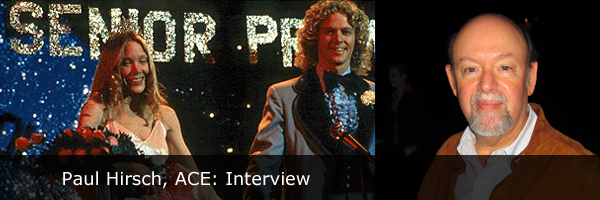
Paul Hirsch, ACE
What is film editing? In one way, it’s an art form in which a
film can come together into a cohesive final cut that audiences
will see. Is it basically about cuts? Cut one scene here,
another one there, and bingo, you have a movie! No, it’s not
that simple. Editing is a combination of factors, including
creating a rhythm and pace, bringing out emotion or tension in a
scene, and essentially creating a story. But it’s also about
keeping the audience interested in focusing their attention on
the screen. Film moves through a projector at 24
frames-per-second (fps). In some instances, even five seconds of
screen-time can be murder on an audience. Long takes, especially
if done repeatedly and if the story isn’t that interesting, can
leave an audience cold. Good editing can take five seconds,
three seconds, or even a few frames of a film, and make them
satisfying to the eye.
Hirsch was kind enough to talk to FSTDVD about his work as an
editor and provides our readers some insight into editing a
film. Does this magician reveal all we need to know about
editing? Not quite, and, as Hirsch will reveal, that's the way
it ought to be.
William Kallay, From Script To DVD: When you
decided on a career in film, was film editing your first choice?
Paul Hirsch, ACE: Yes. I was attracted by the
tools. I always liked to work with my hands, and the power of
the Moviola to stop on a frame, and even go back, was unheard of
in ordinary life.
FSTDVD: Did you learn how to edit in film
school, or on your own?
Hirsch: I was taught how to thread up and
operate a Moviola by a negative cutter I assisted for about 6
months. Based on this little bit of knowledge, I represented
myself as an assistant editor to a company that was seeking to
hire one. It was a trailer house, and the editor there was Chuck
Workman. He was overwhelmed with work, and gave me a 10 minute
"featurette" about the making of "The Thomas Crown Affair"
(1968) to cut down to 3 minutes. The client, UA, liked my work,
and I was given one to do from scratch, on "Chitty Chitty Bang
Bang" (1968). They liked that too, and I started cutting
regularly. I did trailers for "Seconds" (1966), an early Peter
Medak film, as well as for Cassavetes' "Faces" (1968). I then
cut the trailer to "Greetings" (1968), which my brother Chuck
produced, and Brian De Palma directed. Brian and I hit it off
and I cut his next five films. Brian taught me a lot about the
difference between cutting trailers and cutting features. And my
two other great teachers were trial and error.
FSTDVD: On a film production, when does your
job begin?
Hirsch: It depends on my relationship with the
director. Herbert Ross invited me to sit in on the casting of
"Steel Magnolias" (1989). I was there when Julia Roberts read
for him. Sometimes, I just read the script and that's it.
FSTDVD: Once you’ve cut the picture, does it go
to the various sound departments for Foley, ADR, and sound
design/mixing?
Hirsch: Yes and no. It does go out to those
departments, but we don't stop cutting. They simply have to
catch up with whatever changes we make. I once asked Herbert if
he ever "locked" the picture. "Why should I put myself under
that kind of pressure?," he replied.
FSTDVD: “Star Wars” is the film that you won an
Oscar for editing. What are some of the signature scenes that
you cut together?
Hirsch: The robot auction when Luke and his
uncle Owen buy C-3PO and R2-D2; R2 in the canyon captured by the
Jawas; the scene in Ben's home when they hear the urgent message
from Leia; the destruction of Alderaan; the Cantina sequence;
the swing across the chasm; Ben's fight with Vader and his
death; as they escape with Leia, and much of the final battle,
including Luke's trench run. Almost all of these were recuts of
earlier versions that George [Lucas] was unhappy with.
FSTDVD: Does a story dictate the rhythm and
pace of a film, or are these elements you bring to the picture?
Hirsch: Some of the rhythm comes from the
director and the actors; how they play the scenes. Sometimes you
have to take a stronger hand in keeping the pace up to where you
think it should be. I always say to actors, "pause at your own
risk." A pause is an effective tool for an actor, but it can be
overused. An editor has to act as the conductor of the piece,
judging when the tempo is too slow, or too fast, and whether the
movements are too long, etc.
FSTDVD: Has digital editing made your job
easier to do, or do you miss working with film through a
Moviola, or a flatbed editing machine?
Hirsch: I think the Avid made the work easier
and the job harder. It is an enormously powerful tool, and
extremely liberating creatively, since in film, you have to
destroy one version to cut an alternate. It has freed up the
aesthetic possibilities, but it has also invited more people
into the process. It has become somewhat commonplace for groups
to sit behind the editor and suggest changes, like at a [sound]
mix. Nothing good ever comes of this. Decisions made in such
settings are usually policy, not aesthetics. The most successful
pictures I have worked on have, without exception, been the
product of a collaboration between me and the director, period.
This is true of “Star Wars,” “Footloose” (1984), “Carrie,”
“Ferris Bueller’s Day Off,” “Mission: Impossible,” “Steel
Magnolias,” “Falling Down” (1993), and “Ray,” among others.
FSTDVD: What kind of editing equipment/software
do you work on now?
Hirsch: I work on Avids with Unity shared
storage. That's about as much as I know about hardware.
FSTDVD: Editing isn’t merely cutting scenes
together, and making cuts of dialogue work. Can you explain to
our readers some of the additional tricks of the trade you use
to make a scene work?
Hirsch: Magicians never reveal their tricks to
the audience, not to protect themselves, but to protect the
audience. If you understand too much about how the illusions are
produced, it takes away the magic. People can never really know
what goes into editing a movie, anyway, not even other editors.
Sometimes the greatest contribution I make on a picture is
cutting a scene out. It can make the whole thing work, and
watching the finished film, you would never know it.
FSTDVD: Do you work with the director while
editing?
Hirsch: I like to do the first cut on my own,
following only my instinct about how it should be cut. Then, I
work closely with the director to make any changes they wish, to
make it accord more closely with their own particular
sensibility.
FSTDVD: You’ve worked with Brian De Palma on a
number of films. Would you mind telling our readers about your
working relationship with him?
Hirsch: I once asked Brian about a shot I had
seen in dailies, and wasn't quite sure how he wanted me to use
it. "You're the editor, you figure it out!," he replied. So
that's how we work. I cut it, he looks at it, we change it
together.
FSTDVD: Is the style of editing today different
from the days when you started editing? And, if so, how do you
feel it's different?
Hirsch: There are more different styles
employed today. Pictures used to be cut only in a Classic style.
Directors today use styles taken from commercials or music
videos, which I call Mannerist (in the manner of these other
forms). There is less concern about creating the illusion of
real time or real space, and the cut can become the event rather
than the action between the cuts. There is also some
experimentation with Cubist cutting, in which an action or scene
can be depicted over and over from different angles. Kubrick did
this brilliantly in "The Killing" (1956), but he had to rely on
voice-over to guide the audience through it. Today's audiences
are better educated in the language of film and can grasp more
challenging and abstract forms of story-telling. I find that the
fascination with cutting per se, as an aesthetic, is kind of
decadent. The most interesting films, in my experience, result
from characters in whom the audience is interested, and a story
that keeps you wondering, "What will happen next?" The cutting
should be in service of the dramatic effects, not an end in
itself.
Paul Hirsch, ACE Filmography (Source:
www.imdb.com)
Mission: Impossible - Ghost Protocol (2012)
Righteous Kill (2008)
Date Movie (2006)
Ray (2004)
The Fighting Temptations (2003)
The Adventures Of Pluto Nash (2002)
Mission To Mars (2000)
Lake Placid (1999)
Mighty Joe Young (1998)
Hard Rain (1998)
Mission: Impossible (1996)
I Love Trouble (1994)
Wrestling Ernest Hemingway (1993)
Falling Down (1993)
Raising Cain (1992)
Dutch (1991)
Coupe de Ville (1990)
Steel Magnolias (1989)
Planes, Trains & Automobiles (1987)
The Secret Of My Succe$s (1987)
Ferris Bueller's Day Off (1986)
Protocol (1984)
Footloose (1984)
The Black Stallion Returns (1983)
Creepshow (1982)
Blow Out (1981)
The Empire Strikes Back (1980)
The Fury (1978)
King Of The Gypsies (1978)
Star Wars (1977)
Carrie (1976)
Obsession (1976)
The Money (1976)
Phantom Of The Paradise (1974)
Sisters (1973)
Hi, Mom! (1970)
Special Thanks To Paul Hirsch
Photo Credit: Paul Hirsch photo William Kallay (© 2005 From
Script To DVD)
Originally posted here on March 11, 2005