THE BACKLOT
By William Kallay
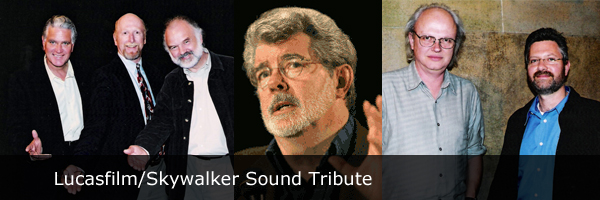
Imagine for a moment that the magicians of Lucasfilm
Ltd. got together with the American Cinematheque of Hollywood and
presented a two-week tribute to George Lucas and his companies, ILM
(Industrial Light + Magic) and Skywalker Sound. What would it be like to
watch rarely shown clips from the "Star Wars" movies, called Bake-Off
reels, on the famous Egyptian theatre screen? How would you feel, as an
ILM aficionado, to watch the evolution of computer effects and
animation, from "Star Trek: The Wrath Of Khan" (1982) to the present day
computer effects of "Star Wars: Episode II—Attack of the Clones" (2002)?
What would it sound like to hear the brilliance of soundtracks recorded
and mixed at Skywalker Sound at reference level? And what would it be
like to be in the presence of the master magician himself, George Lucas?
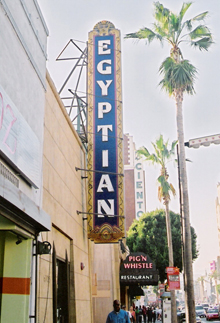
Fans rejoiced, for this all happened at the American Cinematheque’s
restored Egyptian Theatre, for two weekends in a row in February 2003.
The Cinematheque, headed by Dennis Bartok, and Lucas Digital’s Ellen
Pasternack and Suzy Starke, accomplished a rather monumental task of
bringing together many of the people of Skywalker Ranch for these
events. Two years of planning went into the tribute, culminating in a
rare chance to meet some of the people behind the visual and sound
accomplishments performed by ILM and Skywalker Sound. Additionally,
clips from a number of films were shown, including test reels rarely, if
ever, shown in public.
George Lucas Arrives
On opening night of the tribute, filmmaker George Lucas made an
appearance before a sold-out crowd. After receiving a standing ovation,
he spoke about the progression of Skywalker Sound beginning in his
basement to his embrace of digital technology on the recent "Star Wars"
chapters. During the late 1970s and early 1980s, when "Star Wars"
(1977), "The Empire Strikes Back" (1980) and "Return Of The Jedi" (1983)
were filmed, most of the visual effects work was done with miniature
models, matte paintings and optical compositing (marrying multiple
effects elements together into one final shot). The character of Yoda
(Frank Oz) was performed through puppetry. But with advances in digital
computer effects, much of which has been pioneered by ILM’s artists and
technicians, many visual effects sequences could be accomplished that
couldn’t be accomplished before, including a digital Yoda.
“The thing with Yoda in the original films,” Lucas explained, “is...it’s
a hand up his ass! We couldn’t really have him do anything. Frank Oz did
a fantastic job of creating a great performance for him and creating a
character people believed in. We were able to make that work. I knew
that if I were to do the backstory (the prequels) and have Yoda fight, I
couldn’t do it with a puppet. I couldn’t tell the story unless I could
do it digitally.”
Interspersed between the question and answer session between Bartok and
Lucas were clips from the original "Star Wars" trilogy and the two
recent "Star Wars" prequels. The “Bake-Off” reels were edited sequences
that showed off the visual effects for Oscar consideration. These reels
were shown exclusively at the Academy of Motion Picture Arts and
Sciences in 1978. They weren’t shown to the public before, until 2001 at
the Academy’s Samuel Goldwyn Theatre, and now at the tribute.
The Q&A session was extended to allow members of the audience an
opportunity to ask questions. One fan asked about the possibility of
choosing to view the original editions of "Star Wars," "The Empire
Strikes Back," and "Return Of The Jedi" as well as the revised Special
Edition versions of each on their eventual DVD release. To the dismay of
many in attendance, Lucas replied that he has no intention of including
the original versions on DVD. His preferred versions are the revised
Special Edition. ”To me the (original versions) were unfinished, and it
always bothered me,” Lucas stated. Lucas offered no information on the
rumors that the films will be further revised or when they may get
released on DVD.*
Khan! Willow! Anakin!
“ILM and the Genesis of Computer Generated Visual Effects” was night
two’s presentation. Patricia Blau, Senior Vice President of Production
for Lucasfilm; renowned visual effects supervisor Dennis Muren; and
computer effects artist Stefan Fangmeier were present.
Blau took the audience on a trip through ILM’s past, beginning with
early-computerized animation on "Star Trek: The Wrath Of Khan." The
birth of the planet Genesis showed ILM’s early promise of digital visual
effects to come. Some of the achievements included the Stained Glass Man
in "Young Sherlock Holmes" (1985), morphing techniques in "Willow"
(1988) "Terminator 2: Judgment Day" (1991); the advanced computer
animation of the psuedopod in "The Abyss" (1989); fur on “Kitty” in "The
Flintstones" (1994); facial movement in a digital character Draco in
"Dragonheart" (1996), and digital environments in "Star Wars: Episode
II—Attack Of The Clones." The effects in "Khan" were pretty spectacular
in 1982, but the effects as seen in "Star Wars: Episode II," produced
twenty years later, shows how far ILM has advanced itself.
From The Sight Of Scary Dinosaurs To The Sounds Of Sinking Ships
Visual effects artists Dennis Muren and Dan Taylor were on-hand to
discuss their work on the digital dinosaurs of the "Jurassic Park" films
(1993, 1997, and 2001). Disciples of the stop-motion work of Ray
Harryhausen, Muren, and Taylor studied the movements of real animals to
create the weight and pure awe associated with the dinosaurs of
"Jurassic Park." Progression of select effects sequences were shown to
illustrate the monumental task of combining digital dinosaurs with real
people, live environments and digital actors. Once combined, these
elements made the dinosaurs seem very real, scaring up long lines at the
boxoffice each time a "Jurassic Park" film came out.
During the same program, Skywalker Sound’s Chris Boyes spoke about the
complexities of creating a soundtrack for the "Jurassic" films. Many of
the sound effects elements came from the real world.
“I’ve literally recorded every animal on the planet,” said Boyes. The
voice of the T-Rex, for instance, came from a baby elephant. According
to Boyes, it was essential to break down the elements of sound to create
resonating sounds for the dinosaur characters in the films. Establishing
the voice of the T-Rex was one of the keys of making it realistic,
despite the fact the he’s been extinct for over 65 million years.
The James Cameron Connection
Set to make an appearance at the ILM/Skywalker Sound Tribute was
writer/director, James Cameron. But due to the continuing
post-production on his upcoming 3-D IMAX film, "Ghosts Of The Abyss," he
couldn’t make it. The audience that night was still fortunate to be able
to hear from Muren, Boyes, and sound designer Gary Rydstrom.
Visual effects sequences were once again the highlight of the ILM
section of the program. Clips from "The Abyss" and "Terminator 2:
Judgment Day" were shown in magnificent 70mm, and clips from "Titanic"
(1997) were shown in 35mm.
Regarding the visual effects for the groundbreaking "The Abyss," Cameron
was at first reluctant to work with ILM. Muren pointed out that at the
time, Cameron felt that ILM was too big of a company and wasn’t sure if
it could work for him. But after speaking with Muren about some of the
visuals that could be performed, Cameron came away impressed. Muren was
one of the many artists who created the now-famous “psuedopod,” a body
of water that snakes itself through the interior of the submerged vessel
in the film.
Cameron’s involvement with Skywalker Ranch continued on with the
spectacular visual effects and sound design on T2. Gary Rydstrom and
Boyes worked extensively on the film’s signature sound design and
soundtrack. When Cameron approached the sound designers at Skywalker
Sound, he had one request: he wanted the sound to be big. And as it is
well known, Cameron is very much into working on many elements of his
films. On "Titanic," Cameron was insistent that dynamic range on the
soundtrack was used. In other words, loud moments of the ship’s sinking
would be balanced out with quieter moments of Rose’s (Kate Winslet)
journey through the flooded hallways of the lower decks. That way, the
audience wouldn’t be bombarded with constantly loud sounds. The more
constant loud sounds on a soundtrack, the more the loudness becomes more
like “pink noise,” as Randy Thom described later on in the series.
A Tribute To Skywalker Sound
Though it may be hard to believe, Skywalker Sound began in George
Lucas’s basement in the mid-1970s. He enlisted help from a recent
University of Southern California graduate, Ben Burtt, to create the now
famous sound effects for "Star Wars." Flash forward to present day,
Skywalker Sound, as it is now known, has performed sound design, Foley,
sound effects editing, and soundtrack mixing on hundreds of films,
commercials, video games and IMAX large format films. In the process,
the artists and company have collected numerous awards and praise from
the movie industry and audiences alike.
Present for the Tribute to Skywalker Sound were Gary Rydstrom, Randy
Thom, Richard Hymns, and General Manager, Glen Kiser. Each sound expert
spoke about the complexities of culminating hundreds of sound effects
and music into a coherent soundtrack for films.
Clips from "Luxo Jr." (1986), digital sound clips from "Contact" (1997),
"Saving Private Ryan" (1998), "Cast Away" (2000), "Monsters, Inc."
(2001), "Minority Report" (2002), and a 70mm six-track magnetic clip
from Ron Howard’s "Backdraft" (1991) were shown. The soundtracks were
nothing short of stunning. Every nuance of the work by Skywalker’s
Rydstrom, Thom, and Hymns, among others, was clearly heard that evening.
Too bad many audiences, even in this day and age of digital sound, don’t
always hear what the filmmaker and sound designers intended. Paul
Rayton, the chief projectionist for the Cinematheque and his staff,
ensured that the audience was treated to first-class projection and
sound for the first weekend of the tribute.
What? Today’s Visual Effects Aren’t All-Digital?
It may be easy to presume that today’s visual effects are all made
inside of a computer. Though computers have had a major impact on how
fantasy witches and futuristic spaceships fly, much work is still done
in miniature model work. ILM’s Model Shop was in the spotlight during
the second week of the tribute.
Model makers Jeff Mann, Lorne Peterson, and Steve Gawley showed their
remarkable model work spanning back to the original "Star Wars." Many of
the spectacular shots in movies, like the Freeling family home imploding
into ghostly oblivion in "Poltergeist" (1982), the minecar chase in
"Indiana Jones And The Temple Of Doom" (1984), the realistic planes in
"Always" (1989) and the battle arena in "Star Wars: Episode II - Attack
of the Clones" (2002), were works from the ILM Model Shop.
So-called analog models and miniatures have combined in recent years to
push further the visual effects envelope. Mann was a model himself,
having donned a special suit for computer artists to eventually render
the “Stained Glass Man” in "Young Sherlock Holmes." In "Mars Attacks!"
(1996) model sets and CGI were composited for the first time together.
Even though Lucasfilm has been pushing digital technology in film for
years, good old-fashioned model making is still in vogue. So much in
vogue that the models have traveled the world for museum exhibitions.
Ben Burtt And A Thousand Sound Effects
Part of the Skywalker Sound tribute focused on the work of Ben Burtt. As
a film student at the University of Southern California (USC), sound
designer Ben Burtt was known as the “go-to guy” for sound effects. One
day, he was approached by producer Gary Kurtz to create the sound for a
“Wookiee” for a film then called "The Star Wars." He ended up creating
most of the signature sound effects for the film, as well as creating an
entirely new way of how sound effects would sound in films for years to
come.
For "Star Wars," Burtt was tempted to create scientifically oriented
effects, much like those used in "2001: A Space Odyssey" (1968). But
after he approached George Lucas, “science was thrown out the window,”
as Burtt said. And both Lucas and Kurtz wanted stereophonic sound with
an epic feel. The end result was an organic sound design, where even in
the vacuum of space, laser beams swooshed and one could hear the
explosion of a Death Star. Organic sounds, it was reasoned, would
somehow be familiar to audiences. Burtt was rewarded for his work on the
original "Star Wars" when the Academy awarded him a Special Achievement
Oscar for Sound Effects.
Burtt’s work in the "Star Wars" and "Indiana Jones" films broke down
conventional sound effects. Case in point, the punching sounds in
"Raiders Of The Lost Ark" (1981) could’ve been the standard Hollywood
western “slap” sound heard in hundreds of films. Yet Indy’s punches,
though exaggerated, seemed more real and visceral than a real-life
punch.
Another impressive demonstration was the screening of the famous Speeder
Bike sequence from "Return Of The Jedi." This clip, from the 1997
Special Edition and presented in digital sound, showcased how drama
could effectively be achieved entirely through the use of sound effects
rather than music.
The evening was like going back to the glory days of fantastic film
presentation. Among the clips included in the program were vintage 70mm
reels from "Star Wars," "The Empire Strikes Back," "Willow," and
"Indiana Jones And The Last Crusade" (1989). Though some sections of the
reels were faded or scratched, they still were more impressive than many
of today’s prints on newer film stock, and not grainy. And the magnetic
Dolby Stereo sound was rich and full, showcasing Burtt’s and the entire
sound team’s fine work.
Big Stomping Monsters!
"Star Wars: Episode II—Attack of the Clones" was a mammoth production
for Lucasfilm Ltd. George Lucas utilized a number of digital techniques,
from cinematography to effects work to make the film. Part of the ILM
family is a group of digital artists featuring Rob Coleman, Pablo
Helman, and John Knoll, who helped create a number of visual effects
images in Clones. They were featured in a tribute called “The
All-Digital Magic of Star Wars: Episode II—Attack of the Clones.”
As can be seen on the DVD of the movie, digital artists employed a
number of compositing effects to create a scene. One of the best scenes
in the film is the chase through the skyways of Coruscant. Lighting
effects, digital fog, computer generated cars, actors Hayden Christensen
and Ewan McGregor, and digital cityscapes made for a seamless
combination to complete the scene.
Another example of digital workmanship takes place during the attempted
execution of Skywalker, Amidala, and Kenobi in the battle arena. Big
stomping monsters, as they’re lovingly called at ILM, come out of the
arena gates to kill their prey. In a nod to effects wizard Ray
Harryhausen, the digital monsters walked and acted much like those giant
creatures in the old Sinbad films. The artists also looked for
inspiration from real animals in the wild, like elephants and rhinos.
The camera technology was also a subject of this portion of the tribute
with John Knoll, who with his brother, Thomas, developed the popular
Photoshop computer program. In regard to Lucas and the use of digital
cinematography, Knoll commented that, “No question, in my mind, the
whole (motion picture) industry is going that way.” He stated that Lucas
is using the next generation of digital cameras on "Star Wars: Episode
III [Revenge Of The Sith]."
Digital Characters
The next to last tribute** was “Hair, Fur, Feathers & Faces-Making
Digital Characters Look Real.” Rob Coleman, Steve Sullivan, and James
Tooley were on-hand from ILM to discuss their work.
Coleman humorously noted that he was the man responsible for bringing
Jar Jar Binks to life. But he was also responsible for bringing digital
Yoda to life. Like animators in traditional 2D animation, they use their
own face in a mirror at their desk to bring out emotions and looks in
digital characters. Coleman was particularly proud of the performance of
Watto in "Clones." This was an exceptional accomplishment in digital
animation, considering that the first digital character in a live-action
film was the Stained Glass Man in "Young Sherlock Holmes." In contrast,
he was pretty flat and not emotionally engaging. Watto, much like a
human being, expresses emotion through his eyes upon meeting an older
Anakin Skywalker. One senses he is thinking and trying to remember, “Who
is this man?”
Each artist showed pictures and video of some of their work. One of the
buzz words as of late in film is using a “digital double.” ILM is well
in tune to using them. Many of the puppies in "101 Dalmatians" (1996)
were digital doubles. Many stunts are now performed by digital doubles.
In the case of Clones, some parts of Count Dooku’s face, played by
Christopher Lee, were digitally inserted on a stunt double. One has to
look real close to see these tricks of the ILM trade.
Final Analysis
For those who grew up watching and hearing the films that ILM and
Skywalker Sound worked on, the tribute was astounding. Here was an
opportunity to listen to George Lucas, in a rare public appearance, talk
about the marvels of "Star Wars." For all of the criticism of the latest
chapters in the "Star Wars" films, and Lucas’s extensive use of CGI and
blue- and green-screen, even some of the most jaded critics could
appreciate his vision of making epic films with state-of-the-art
technology. If his films are too technical, why do people still show up
in droves to see them?
This was also a chance to meet, or at least listen to, some of the
people who work at Skywalker Ranch. In the world of visual effects and
sound, the names of Muren, Burtt, and Rydstrom, to name a few, are the
equivalent of top tier athletes in the world of sports. Their gathering
was like attending an all-star game.
The precedent that George Lucas set for ILM and Skywalker Sound
(previously known as Sprocket Systems) back in the mid-’70s, carries on
through the beginning of the 21st century. From the hum of lightsabers
to the ferocity of The Hulk, the magicians of Skywalker Ranch will
continue to amaze audiences for years to come.

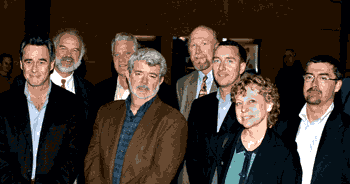
Special thanks to Ellen Pasternack, Dennis Bartok and his staff,
Suzy Starke, and Michael Coate
*The original Trilogy appeared on DVD on September 21, 2004, and
indeed contained a number of changes to the original films.
**The author of this article was unable to attend the final tribute
in the series, “ILM: Into The 21st Century.”
This article was originally posted at
www.widescreenreview.com
in early 2003.
Revised version posted here on September 27, 2004
Photo Credits
William Kallay (© 2004 From Script To DVD) (except for George
Lucas photograph-credit unknown)