THE BACKLOT
By William Kallay
Sometime during the early-1980s, I became hooked on a brand-new show
that covered the movie industry called "Entertainment Tonight."
The show, way before the current glitz and glamour shows of today, was
as professional and investigative as "60 Minutes" and "20/20." It
was a half-hour of syndicated television that focused on not only movie
star interviews, but it also covered weekend box office take at a time
when such information was less-common and not so sensationalized.
One of the most enjoyable aspects of the show featured a critic and film
historian named Leonard Maltin.
Maltin was a breath of fresh insight into the movies. His jovial
demeanor and incredible knowledge of all types of films, from comedies
to epics, from animated gems to little seen films, was purely enjoyable.
His delivery wasn't dry and stoic like a college professor might be.
It was friendly and approachable, yet polished. This was a guy
that almost any fan of the movies would love to listen to for hours
about movies of all types.
He's come a long way from those early days of "ET." Not only is
Maltin still featured on that show (now in its 24th season), he has been
host on a number of cable channel introductions to films (like Starz!
and Encore), and he's also hosted the excellent "Walt Disney Treasures"
series of DVDs.
Television is but one part of Maltin's resume. He was a published
author by the age of 18. Many film lovers are familiar with his
books, "Leonard Maltin's Movie Guide" (annual, Penguin Group), "Of Mice
And Magic" (1980, Penguin Group), and a personal favorite of mine, "The
Disney Films" (Disney Editions), now in its fourth edition.
He's also self-published, having created
"Movie Crazy," an online and
print newsletter in which he focuses on little known films from the
silents to today, and has observations about the film industry. It
is recommended to go to Maltin's site to get not only issues of "Movie
Crazy," but to see the rest of his bio, which is too large to print
here!
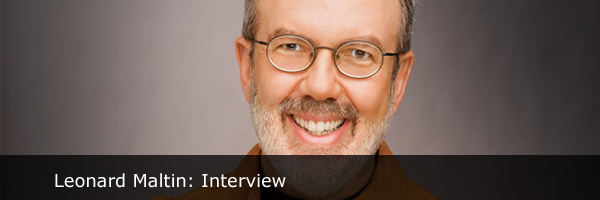
As you'll read, Maltin is passionate about the movies. Despite his
incredibly busy schedule, Leonard was kind enough to do an interview
with FSTDVD.
William Kallay, From Script To DVD: Do you remember
when you caught the “film bug?”
Leonard Maltin: I was part of the first TV generation—I
was born in 1950—so when I was growing up, television was a living movie
museum. Every day I immersed myself in cartoons and comedy shorts of the
1920s, 1930s, and 1940s, and I couldn’t get enough of them. I was also
entranced by Walt Disney’s weekly TV show, especially the episodes in
which he’d take us behind the scenes and show how animated films were
made.
FSTDVD: What are some of your earliest film memories?
Maltin: I have a very clear memory of my mother taking
me to see a revival of "Snow White And The Seven Dwarfs;" I must have
been four or five years old, and I remember it was at the Guild Theater,
behind Radio City Music Hall on 50th Street (the movie theater that
always seemed to be a mistake—or at best an afterthought). In those days
movies played continuously, and as the crowd started leaving she took my
hand and we walked in to see the last shot of the movie—Snow White being
taken off by Prince Charming against a bright golden sky. That image is
burned into my brain.
FSTD: Where were you raised?
Maltin: I was born in Manhattan, but grew up (from the
time I was four years old) in Teaneck, New Jersey, a suburb.
FSTDVD: When did you start pursuing film
critique/history as a career?
Maltin: I don’t know that I ever thought it could be a
career. I started writing about movie history when I was twelve or
thirteen years-old and simply had to do it—in part because I loved to
write, and in part because I’d gotten hooked on the subject. I never
thought I’d actually be able to make a living at it.
FSTD: You’re well known as a film historian of
animation, old-time film, but many know you as the author of “The Disney
Films.” Can you tell our readers how that book came about?
Maltin: When Walt Disney died, I decided to devote an
entire issue of my fanzine, "Film Fan Monthly," to an annotated listing
of his films. To my great surprise, the folks at the Disney studio
requested extra copies because they didn’t have such a list! (This was
before Dave Smith was hired to be their full-time archivist.) When I
made my first trip to Los Angeles, the man who was then head of
publicity for the studio encouraged me to expand the magazine index into
a full-fledged book, and that’s exactly what I did. For the next year I
screened every single Disney feature film (and a great many of the
shorts), in chronological order, made notes, and then started writing.
FSTDVD: You’ve written about a number of different film
subjects, ranging from Charlie Chaplin to movies on DVD. Do you have a
particular favorite film genre? Do you tend to gravitate towards
comedies of Chaplin, or do you prefer epic movies, etc?
Maltin: Years ago I would have replied “comedy” without
hesitation... but today, that might seem a misleading answer at best,
insulting at worst. What passes for comedy nowadays is very discouraging
to me. I was weaned on the classics, beginning with Charlie Chaplin, and
continuing with Keaton, Lloyd, Laurel and Hardy, The Marx Brothers, The
Three Stooges, etc. That’s still my idea of comedy, although every now
and then I see a ray of hope, in films like Paul Weitz’s "In Good
Company" or the work of Alexander Payne and Jim Taylor.
FSTDVD: You’re on television and radio. You author
books, articles, and conduct interviews with actors and filmmakers, and
even find time to make speeches as various awards shows and film expos.
Plus, you teach at USC. Where do you find time to relax? And how do you
relax?
Maltin: I love to read; that’s my favorite form of
relaxation. I also love jazz and try to hear live music whenever I can,
which isn’t often enough.
FSTDVD: A friend of mine met you and talked with you
some years ago, and you told him that one of your neighbors is renowned
make-up artist, Rick Baker. Is it true that he helps you create your
Halloween costumes & make-up for your family?
Maltin: No, this only happened once, many years ago,
when our daughter was young and was going to attend a neighborhood party
where the parents were required to come in costume as well. My wife
Alice, and daughter Jessie, decided to go as mother-and-daughter clowns,
and Alice asked Rick if he’d be willing to make her up. He couldn’t have
been nicer about it... but when he came to the door that Halloween
afternoon, he was already made up as the wicked queen from "Snow White
And The Seven Dwarfs!"
FSTDVD: How did you become involved with “Entertainment
Tonight?”
Maltin: I appeared on "The Today Show" in May of 1982
to promote my book "The Great Movie Comedians," and quite by chance, a
young man in the research department at Paramount Television saw me. He
called the executive producer of "ET," which was then in its first
season, and said, “You’re looking for a new film critic, aren’t you?”
The producer, Jim Bellows, said yes, and my “talent scout,” Gary Hart,
said “I saw a guy on the 'Today' show this morning that you ought to
check out.” A few days later my phone rang in New York City and they
asked me to fly to L.A. for an audition. They ran my audition tape the
next night, and I’m still there.
FSTDVD: Prior to being cast on that show, had you had
prior television experience?
Maltin: My only experience was as a guest, plugging my
books, and while I’d done that quite a bit, it’s entirely different from
speaking directly into a camera. It also took me a long time to learn
how to write for television—to be heard, not read.
FSTDVD: Have there been any moments when you’ve
interviewed a famous actor, or a famous director, and you walk away from
the interview saying to yourself, “Wow, I just interviewed one of the
greats?"
Maltin and actor Jimmy Stewart on the set of a Frank Capra tribute for
"Entertainment Tonight"
Maltin: I’ve often felt that way. I’ve been so lucky to meet a great
many of my heroes over the years, and I’ve never become jaded about it.
When I attended my first Golden Boot Awards, I met Roy Rogers and Gene
Autry within five minutes’ time!
FSTDVD: I don’t know if you’ve noticed, but From Script
To DVD is filled with “lists” of films. We’ve compiled lists of
everything from the original “Star Wars” Trilogy engagements, to small
lists of films. Many of your books, including your “Movie Guide,” are
detailed lists of films. That must be an astounding amount of
information to remember. How do you keep track of so much material?
Maltin: Editing or writing a reference book requires a
peculiar set of skills, including an affinity for details. I don’t know
how to explain it better than that.
FSTDVD: Animation seems to be of great interest to you,
almost no matter what studio produced it. Warner Bros., MGM and Disney,
just as examples, all had their distinct style during their heyday in
the 1940s. Of course, Disney had a more recent “Golden Age” with the
likes of “Beauty And The Beast” to “The Lion King.” What do you make of
the recent shift from traditional 2-D animation to 3-D computer
animation? Is this a step in a positive direction, or do you think that
2-D, with the right story, could be revived?
Maltin: I feel like shaking some Hollywood executives
by the collar and shouting, “It’s the story, stupid!” I think "Shrek"
would have been a hit if it had been animated with matchsticks. It’s the
screenplay and voice work that made that film popular, not the
unattractive characters or the 3-D animation. On the other hand, the
people at Pixar follow the model of building story and character set by
Walt Disney in the 1930s, so they know just what they’re doing. If there
are several 3-D flops in a row, someone may get the idea that it’s not
about the technology after all.
FSTDVD: You were the host on the recent "Walt Disney
Treasures" series of DVDs. I was impressed by how you pointed out to the
audience a historical perspective on how to look at the films today. One
film that has been craved by Disney fans for years is, of course, “Song
Of The South.” Do you think this is a film that can, and should, be
available for audiences to watch, or buy, on DVD?
Maltin: I’m a great admirer of that film, and I would
love to see it come to DVD. I know there has been some discussion at the
Disney company about doing it, but there is also great trepidation. I
hope they make the right choice.
FSTDVD: I’m sure you’ve been asked this question
before, but do you believe films made today are better or worse than
those made, say, in the 1930s and 1940s? Some critics contend that the
1970s was the last great movie decade (though many seem to forget that
there was an extraordinary amount of garbage put out back then). What
are your thoughts on films made today?
Maltin: Too many times nowadays they make the deal
instead of the movie... or the film is made by committee instead of
being the work of a writer or director with a passion to tell a story.
The movie studios were factories back in the 1930s, too, but they had
better craftsmen then, so that even some of the formula films had, at
the very least, good storytelling to their credit.
FSTDVD: Do you have any thoughts regarding the push by
some filmmakers and studios for digital cinema?
Maltin: I’ve been very impressed with digital
projection, and I think it could be a good thing, but when I go to movie
theaters and see sloppy, careless presentation, I get the sinking
feeling that they’ll find a way to screw up digital presentation the
same way they do 35mm projection today. In fact, when I saw Oliver
Stone’s "Alexander" last November at a local theater, projected
digitally, the film began in the middle of the Warner Bros. logo, and
the soundtrack skipped at least three times!
FSTDVD: Is there anything you miss about how films are
shown today, as opposed to days past?
Maltin: I’m the guy running up the aisle to complain
about focus or sound almost every time I go to a theater. That gets
tiresome. And you can’t get them to fix the masking, even when it’s
obvious that some of the image is spilling off the screen right and
left. There doesn’t seem to be any care, let alone showmanship, in most
movie theaters, at least the ones I go to. Then they have the nerve to
talk about a box-office slump!
FSTDVD: Can you tell our readers about your
publication, “Movie Crazy,” and why you decided to publish it?
Maltin:
Several years ago I became frustrated because I no longer had an outlet
where I could write (or talk) about my first love, movie history... so I
decided to do what I did when I was a teenager and publish myself. I’m
now on issue #13 of my quarterly journal for old-movie buffs and I love
every minute of it. I launched a web site as a means of telling people
about the newsletter, but the site has taken on a life of its own.
FSTDVD: Are there any films you’re looking forward to
seeing this year?
Maltin: I’m eager to see Woody Allen’s "Match Point."
I’m looking forward to Disney’s "Chicken Little," and of course I’m very
curious about Peter Jackson’s "King Kong."
Special thanks to Leonard Maltin
IMAGES: "Entertainment Tonight" © Paramount Pictures
Originally posted here on October 7, 2005